


Free
9174804003 candidate.class@gmail.com
ABSTRACT:- The stresses transmitted by the structure are bear by the soil bed. If soil is weak than it is not stable enough to resist the structure’s heavy load, for this the soil should be reinforced and stabilized. The ability of the soil to distribute the load over a greater area is generally increased when the quality of the soil is increased to an extent. The term “Soil Stabilization” refers to the change in the properties of the soil to such an extent that its stability or bearing power is increased. It can be done by various different methods like; mechanical, chemical, or by using different types of additives which can be mixed in the soil. Conceivable growth cannot be done without the adaptation of the new technology to make the structure stable. Soil stabilization by the using waste coir fibres and rubber tire waste material is one of the most cost-effective approaches. The most common achieved improvements through the process of stabilization include the better soil gradation, reduction of the plasticity index or the swelling potential, and increase in the durability and the strength of the soil. This work is done in order to find out the strength of soil by reinforcing with randomly distributed waste coir material and the waste rubber tire with the changeable percentages of the reinforcements. The tests carried out in this research work are executed as per the Indian Standard Specification. The results obtained are compared and inferences are drawn towards their usability and efficiency to make these waste fibre materials for unlike geotechnical application as a cost efficient advancement. The samples are prepared at their respective maximum dry density and optimum moisture content. From the study, it is observed that the friction angle increases by 26% at fiber content of 0.5% and fiber length of 6mm. The fiber-reinforced low plasticity clay exhibited crack fracture and surface shear fracture failure modes, implying that polyester fiber is good earth reinforcement material with prospective applications in civil engineering.
METHODOLOGY
APPLICATIONS
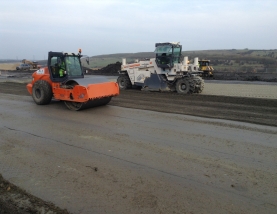
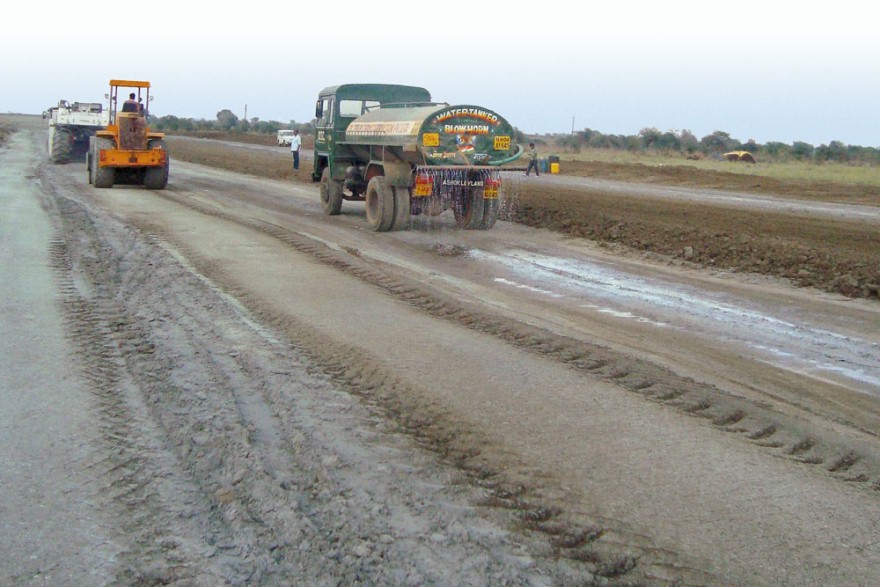
Soil stabilization has many applications in earthwork construction, such as soil modification, roadway embankment reinforcement and earth slopes, landfills and embankments.
II. MATERIALS AND THEIR PROPERTIES
SOIL
The soil sample was brought from a place near government hospital RIMS, Sri Kakulam at a depth of 2m below the ground surface. The soil is initially allowed to dry for 2days and the dried soil is thoroughly grinded. The grinded soil is allowed to pass through 4.75mm IS sieve and this soil is used for the present study.
COIR
The following are the different physical and chemical properties of coir.
PH: 5.4-6.8.
Perfect for use as a growing medium.
CARBON/NITROGEN:
Ratio of b/w 90:1and 110:1.This combined with coir’s lignin content makes it a good long term growing medium.
NUTRITION:
Coir contains a useful amount of available potassium and small quantities of:
Boron
APPLICATIONS OF COIR:
Geo-textiles and related products have many applications and currently support many civil engineering applications including roads, airfields, railroads, embankments, retaining structures, reservoirs, canals, dams, bank protection etc…. Coir can improve soil strength at a lower cost than conventional soil nailing. In addition, coir allows planting on steep slopes, further securing the slope. Coir (coconut fiber) geo-textiles are popular for erosion control, slope stabilization and bioengineering, due to the fabric’s substantial mechanical strength. Coir geo-textiles last approximately 3 to 5 years depending on the fabric weight. The product degrades into humus, enriching the soil.
RUBBER TIRE:
The diameter of the tire is up to 3mm and length is 1-2cm. The following are the different properties of waste rubber tire.
CHEMICAL COMPOSITION
Approximately 80% of the weight of car tires and 75% of truck tires is rubber compound. The compositions of tires produced by different manufactures are reported to be similar. Table shows the material composition of passenger car and truck tires from the European Union (EU) as well as the composition of tire rubber from Canada.
APPLICATIONS OF TIRE WASTE:
1. Sub grade fill and Embankment.
2. Backfill for wall and Bridge Abutments.
3. Sub grade insulation for roads.
4. Landfills.
5. Septic system drains fields.
MIXING PROCEDURE:
Soil passing through 4.75mm IS sieve is used for the present study. To this soil sample required percentage of stabilizer by weight is added and a uniform mixture is made. For this mixture water is added and properly mixed in order to ensure the bonding of fiber and soil. The prepared sample is tested for maximum dry density, optimum moisture content, unconfined compressive strength, direct shear test and CBR value. This procedure is repeated for 0.25%, 0.5%, 0.75% and 1% of coir and for 1%, 2%, 4%, 6%, And 8% of tire waste.
CONCLUSIONS


| Doc | Complete Document IN MS -Word about soil stabilization |
